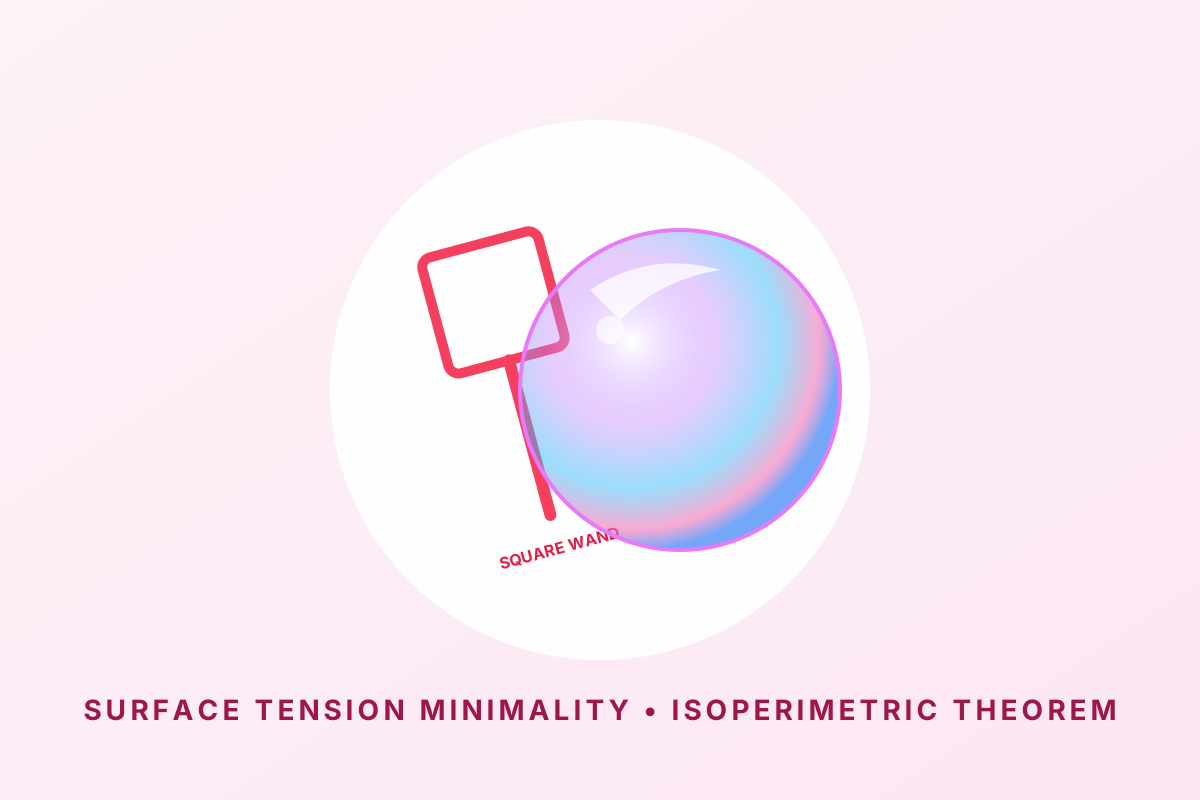
Children's toy stores frequently sell novelty bubble wands shaped like stars, hearts, diamonds, and triangles. Yet no matter how intricate the plastic outline you dip into soapy water, the moment a bubble detaches from the wand and drifts into the breeze, it snaps into an exact, perfect sphere.
This stubborn refusal to adopt fun shapes is dictated by the relentless physics of surface tension. Water molecules are strongly attracted to one another through hydrogen bonding. In the interior of a liquid, each water molecule is pulled equally in all directions by its neighbors; on the exposed surface, however, molecules lack neighbors above them and are dragged strongly inward toward the liquid center.
When you add soap surfactant to the water, it lowers surface tension just enough to allow the water film to stretch without tearing. But the inward cohesive pull remains active. The liquid membrane behaves like a stretched rubber balloon, continuously contracting until it occupies the absolute smallest possible surface area that can contain the volume of trapped air.
In three-dimensional Euclidean geometry, the famous isoperimetric theorem proves that a sphere is the one and only mathematical shape that encloses the maximum volume with the minimum surface area. As the bubble floats through the air, pressure distributes symmetrically across the elastic membrane, holding it in spherical harmony while thin-film light interference paints swirling rainbow colors across its skin.
Key Takeaways
- Surface tension forces liquid films to contract into the smallest possible surface area.
- The sphere is mathematically the only 3D shape that minimizes surface area for a set volume.
- Wand shape only matters during inflation; upon detachment, surface cohesion shapes the sphere.