Almost every highway driver has endured the baffling frustration of a phantom traffic jam. You are cruising down a three-lane interstate when brake lights illuminate, forcing thousands of cars into an agonizing stop-and-go crawl for twenty minutes. Then, just as suddenly, the road clears and traffic speeds back up to 70 mph without any evidence of construction, debris, or a police vehicle.
Physicists and civil engineers study these mysterious delays as traffic shockwaves or jamitons. In free-flowing traffic, cars behave like molecules in a low-density gas, moving independently. But as vehicle density rises past approximately thirty vehicles per kilometer per lane, the traffic stream undergoes a phase transition, behaving like an incompressible fluid.
In this high-density state, if one driver taps their brake pedal for just half a second: perhaps to glance at a highway sign or adjust their lane position: the driver immediately behind takes about one second to react and brakes slightly harder to preserve safety distance. The third driver brakes harder still. Because human reaction times introduce a non-linear delay, each successive vehicle slows more abruptly than the last.
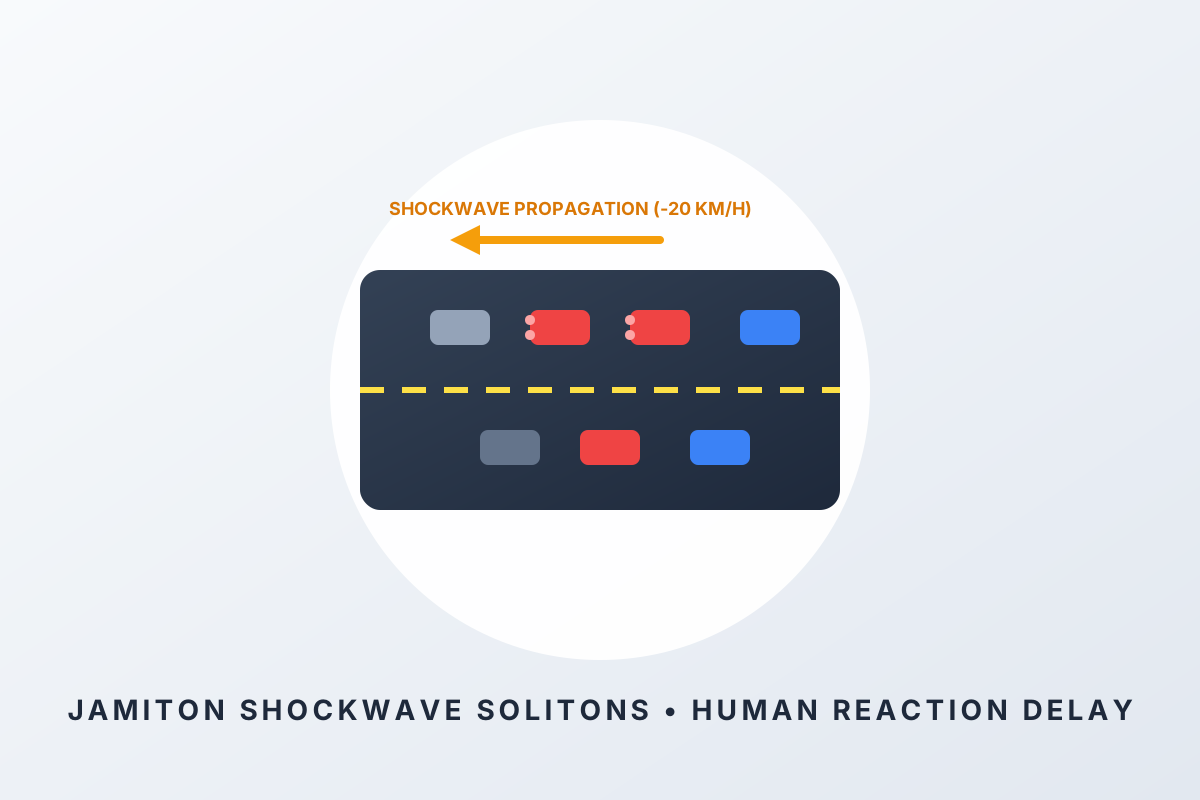
This deceleration wave propagates backward along the highway against the flow of travel at roughly twenty kilometers per hour. A two-second brake tap at 8:00 AM can generate a self-sustaining shockwave that halts hundreds of cars miles upstream hours later. Mathematical models and real-world trials confirm that maintaining steady following distances and deploying adaptive cruise control can actively dissolve these shockwaves before they form.
Key Takeaways
- Phantom jams (jamitons) occur when dense highway traffic transitions into a fluid-like state.
- Human reaction time delays cause minor brake taps to amplify backward into complete standstills.
- The resulting compression shockwave travels backward through highway traffic at roughly 20 km/h.