Stand in front of a bathroom mirror and raise your right hand. Your reflection raises what appears to be its left hand. Yet your head remains faithfully at the top and your feet remain anchored at the bottom. This classic riddle has puzzled observers for generations: what special property makes a mirror reverse left-to-right without reversing top-to-bottom?
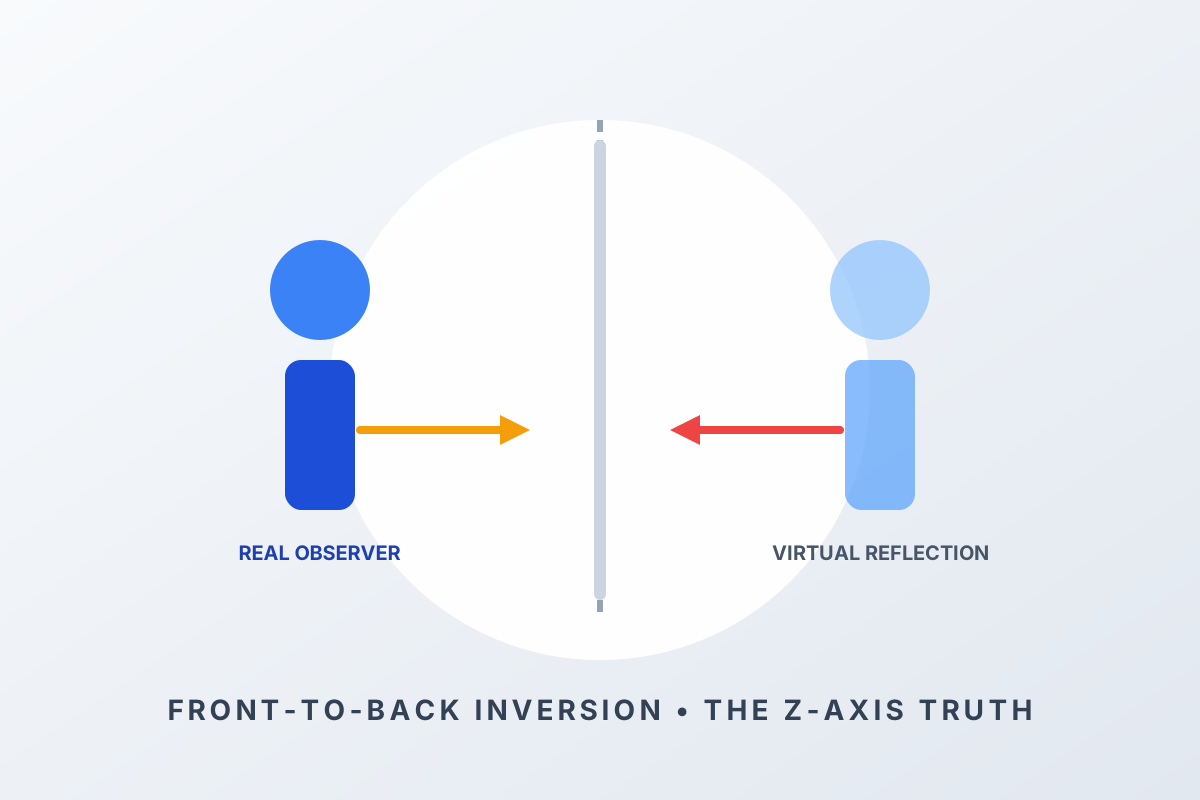
The counterintuitive answer is that mirrors do not reverse left and right at all. If you point toward the east, your reflection points toward the east. If you point up at the ceiling, your reflection points up at the ceiling. The only direction the mirror inverts is the one perpendicular to its glass plane: the front-to-back z-axis.
Consider a rubber glove or a rubber stamp. When you press a stamp onto paper, the image is inverted front-to-back. If you wore an arrow on the front of your shirt pointing forward toward the glass, the mirror image would show that arrow pointing straight back at you. Light travels in direct, straight paths from each point on your body to the glass and reflects directly backward at an equal angle.
The horizontal reversal is an internal psychological trick. Because human bodies are bilaterally symmetrical, we imagine rotating ourselves 180 degrees around a vertical spine axis to step into the mirror's shoes. In performing that imaginary mental turnaround, our minds flip left and right, and we mistakenly blame the glass for our own cognitive gymnastics.
Key Takeaways
- Mirrors reflect light straight back, inverting only the perpendicular front-to-back z-axis.
- Up remains up, and east remains east: no horizontal or vertical inversion takes place.
- The perceived left-right flip comes from our brain mentally rotating our bodies to face ourselves.